NeurIPS 2024

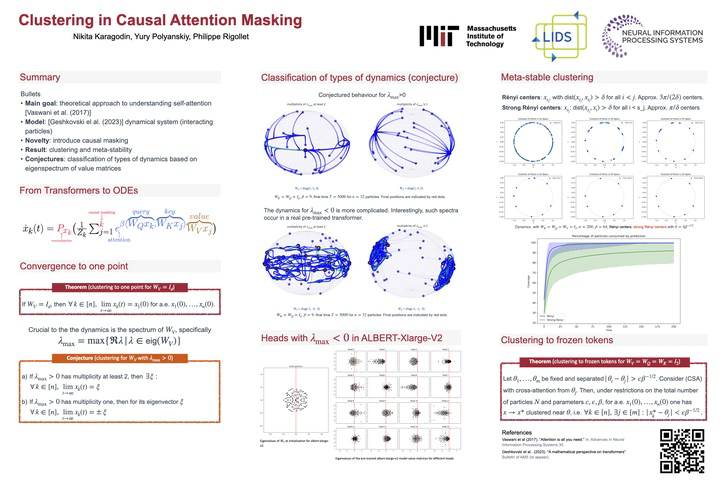 My poster
Welcome 👋
I am happy to present my first graduate paper Clustering in Causal Attention Masking as a poster at NeurIPS 2024. The main goal of this work is to better understand self-attention from theoretical perspective, by modeling propagation of tokens through layers as an interacting particle system.
The main system
Similar to how ResNets are studied via neural ODEs, one can write down the dynamical system that models propagation of tokens through layers of a pre-trained transformer, see Geshkovski et al for a fundamental introduction into this model. After several assumptions we arrive to the main equation. Tokens, represented as vectors $x_k, k \in [n]$ on a $d$-dimensional unit sphere (this assumption comes from normalisation layer), evolve according to a system of non-linear differential equations
$$ x_k = P_{x_k}(\frac{1}{Z_k} \sum_{j=1}^k e^{\beta \langle W_Q x_k, W_K x_j, \rangle} W_V x_j), $$where $W_Q, W_K, W_V$ are standard query, key and value matrices in transformers architecture, $\beta$ is a hyperparameter, $Z_k$ is sum of attention weights (so that they sum up to one) and $P_{x}(y) = y - \langle y, x\rangle x$ ensures that tokens stay on a unit sphere.
Convergence to one cluster
This system, in a sense, is a generalisation of the famous Kuramoto model. In that sense, the following result is a continuation of a long line of works dedicated to synchronisation phenomena. For us, it can be seen as a negative property, because it tells us that deep transformers tend to collapse.
We prove that for
$$W_V = I_d$$almost any initial configuration of tokens converges to one point. Moreover, we conjecture that for large timeframes, the largest real part of an eigenvalue of $W_V$ that we denote $\lambda_{\max}$ determines the complexity of the dynamics.